
Project
Understanding mechanisms underlying insects’ host choice is important to the study of plant-insect interactions. Plants emit a variety of volatile organic compounds (VOCs) that play multiple roles in plant-insect interactions; they are important cues for insects to locate an appropriate host plant or mating and oviposition sites. Insects of Curculionidae family, because of their almost exclusive preference for specific plant host genera, offer an ideal candidate for studying these plant-insect interactions.
The chestnut weevil, Curculio elephas, is a weevil native to Southern and Central Europe, which feeds on the nuts of chestnuts and oaks.
While, many aspects of the biology and ecology of the chestnut weevil have been studied, scarce research has been conducted to examine the important ecological chemistry behind this highly host-specific plant-insect system. No studies have been reported so far for C. elephas regarding its response towards VOCs emitted by its host plant.
CENOTOMA targets an interesting system that has not been explored in depth. It will further contribute to scientific progress by extending our knowledge on this highly host-specific plant-insect system and to the elucidation of the chemical ecology that underpins insect plant interactions.
The main objective is to find key compounds that act as attractants for C. elephas females that will enhance a comprehensive integrated management strategy to control C. elephas population and promote economic, environmental and social impact of chestnut cultivation.
Biological circle of Curculio elephas
Oviposition begin in August and continue until September. Each females can lay 25-50 eggs. Female punctures the nut with their rostrum and deposit eggs into the hole.
Adult emergence occur during summer.
Most larvae pupate the following year (late spring and early summer), but some of them may pupate after 2-3 years.
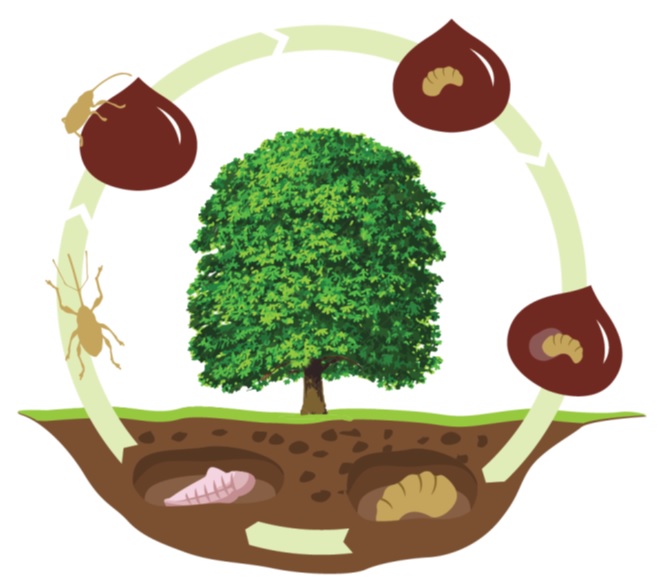
Incubation last approximately one week. Young larva digs a gallery inside the chestnut.
Larval development is completed inside the fruit (30-40 days), the insect chews an exit hole in the surface of the nut.
Usually, the infested nut drops to the ground. Once out of the nut and on the ground, larva bury itself 5-20 cm in a small cell.
Larva spends the winter in diapause.
Elucidating the chemical ecology behind this highly host-specific plant-insect system, results from CENOTOMA will generate multidisciplinary scientifically-based knowledge. Results will shed light on C.elephas– chestnut interactions.
The identification of behaviorally relevant odorants will bring novel insect control methods that contribute increasingly to food and environmental security. CENOTOMA will set up and promote new guidelines to researchers, growers, stakeholders, commercial diagnostic laboratories, government staff and the general community to insect control.
The overall impacts of the scientific research will enhance:
the environmental sustainability though the limitation of pesticides and plant protection products and the application of more environment-friendly products. The chestnut cultivation will reinforce the conservation and the preservation of natural resources.
the economic sustainability. Application of the project’s results will improve product quality, yield and commercialization for a higher added value. The results will offer to the developers of the trap technology, the major tools for foresight, clever marketing, and an understanding of the needs of growers.
the social sustainability, by securing available marketable nuts, will increase employment and people involvement in the development and application of the processes of integrated pest management.
the reinforcement of the Greek research community. It will strength the collaboration among researchers and give research incentives for the new scientists, by enhancing interaction, knowledge transfer and research.

